
Faith Forward Democrats
After decades of watching Democrats dodge the God question, I think they finally have an answer.
I recently found a years-old copy of a national political magazine that I had written the cover story for titled “Will Democrats Ever Get Religion?” It was a piece building off of the subtitles of one of my impactful books, God’s Politics: Why the Right Gets It Wrong and the Left Doesn’t Get It. I smiled as I looked at this piece from over twenty years ago asking the same question I still find myself wondering even now.
For decades now in America, the Republican party, has claimed to own religion and religious values. They proceed to use, abuse, co-opt, and reduce religion for their own political agenda. Faith should stay private they say, except for the “moral values” issues like abortion and gay marriage. Of course, that is bad theology. It is unbiblical theology, ignoring the more than 2000 verses in the Bible that focus on the poor and oppressed. But Republicans want to command religion in America.
That is made easier by the Democratic Party, which tends to ignore, dismiss, or even discredit religion. Part of the reason why Democrats don’t talk much about faith is that they struggle to know how to express it without sounding like they are proselytizing or imposing their religion upon a pluralistic society.
I cannot count the number of times that Democratic Senators and members of Congress– many of them names you’d recognize- have asked me privately how to talk about their faith. They don’t want to “wear it on my sleeve,” or make people feel uncomfortable, or offend those of other faiths or no faith at all. They have concerns around expressing their own faith alongside their strong commitment to the separation of church and state. And while all of that is all understandable, the reluctance to speak about faith has ceded religion to the Republicans.
This despite the fact that Black women, the strongest and most consistent Democratic voting group across any racial or gender demographic group, are also the most religious group across any racial or gender breakdown.
The other factor is what I call “secular fundamentalism.” I have been fighting religious fundamentalism most of my life, with the public description of being an alternative to the Religious Right–which gets tiresome. But there is a bias against religion per se in some parts of the political and cultural left, which is just as irrational and openly prejudiced as religious fundamentalism is.
All this makes many Christians committed to social justice often feeling without a party’s support, and sometimes even politically homeless.
I strongly believe that faith communities should be morally independent of party politics, and their values should both help challenge and shape both political parties. But an amazing thing seems to be happening.
An increasing number of Democratic office holders and candidates in upcoming elections are no longer apologetic about their personal faith. Indeed, they want to apply their own devout faith into the social arena where so much is at stake for justice and the common good, beyond the individualism of private religion.
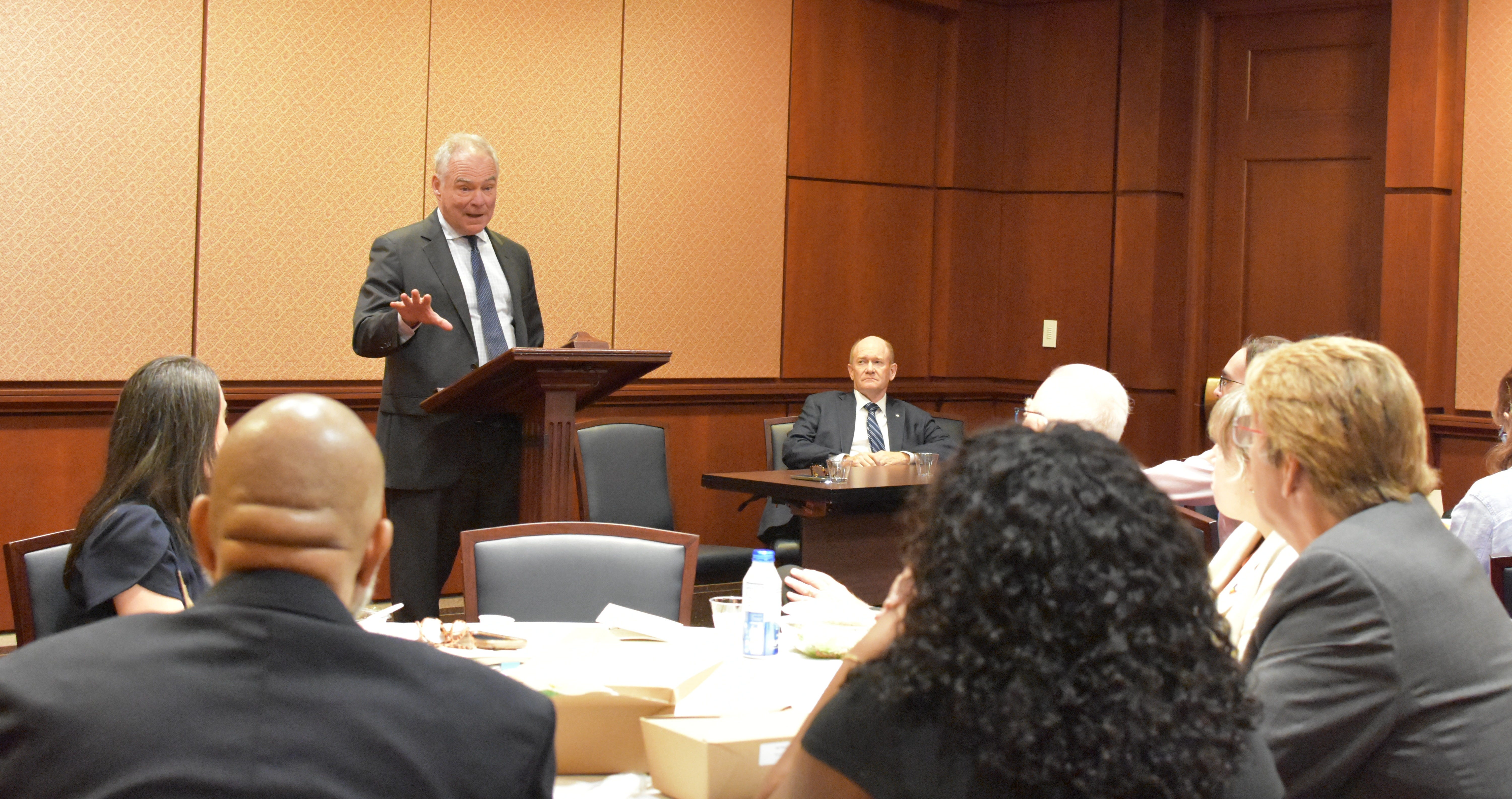
I spoke to Senator Tim Kaine, from Virginia, who has just coined a new phrase, “Faith Forward Democrats”.
For Tim his Catholic faith and, in particular, serving as a young Jesuit volunteer alongside poor people and families in Honduras shaped the rest of his life and career as a civil rights lawyer and now a U.S. Senator.
We had a very encouraging discussion of how a new group of Democrats who are not afraid to put their faith forward, while being deeply committed to a pluralistic country of people with many faiths and no faith whatsoever. Together, they can all work for the common good–a core goal of Catholic social teaching.
Kaine is close with other faith-forward Senators, including Chris Coons of Delaware, who attended Yale Divinity School alongside Yale Law School. And now Rev. Raphael Warnock of Georgia who, despite now serving in the Senate, is still the pastor of the historic Ebenezer Baptist Church in Atlanta, the home congregation of Rev. Dr. Martin Luther King Jr.. Senator Cory Booker was also forthright about his faith during his historic 25 hour fast on the Senate floor, where he and Coons had a long discussion about what we are called to do by Scripture.

The electoral landscape is changing too. A new generation of candidates is speaking openly about faith as a guiding force in their campaigns. Now running for the Senate, are Methodist clergyman Adam Hamilton from Kansas with a diverse political church of 24,000 members. Former Presbyterian seminarian James Talarico is running in Texas, and has given faith and politics a fresh face. Minnesota Lt. Governor Peggy Flanagan, a devout Catholic and indigenous leader, is now running for the Senate, as a former community organizer who is close to the ground in people’s lives.
Running for Congress now for the House of Representatives is Rev. Freddy Haynes, pastor of Friendship-West Baptist Church in Dallas, and is perhaps the leading Black revival preacher in the country. And a new Iowa House candidate and Lutheran minister is Rev. Sarah Trone Garriott. If they win, they will join other deep leaders of faith in Congress like pastor and Representative Emmanuel Cleaver, the former Mayor of Kansas City, and others.
This is a striking shift in American politics. Especially in a moment when religion is being dangerously manipulated and weaponized by Christian nationalists for their own political agenda.
These Democrats are reclaiming religion, not as a partisan weapon, but as a moral framework for public service. Many of them meet regularly with Republican colleagues of faith at a weekly Senators prayer breakfast. Conversation about the moral values of public life are taking place, before, after, and maybe even during prayer times.
We are seeing a dynamic that is finally changing. These “faith forward Democrats”, as Senator Kaine calls them, are showing that faith can be spoken in the language of compassion and justice, dignity, religious freedom, human solidarity, and service to the neighbor. For the first time in a generation, Democrats are learning to speak of faith with authenticity instead of apology.
They do not want to use faith to impose beliefs on others, or hiding their faith in private, but letting it shape their conscience, judgments, and decisions in public life.
Faith may be our last line of defense in saving, and then restoring, our democracy.
Tim Kaine talks honestly and powerfully about privileged people needing to take risks in the trajectory to dictatorship. Are we up to this test of our faith in God and belief in democracy?
Decades after I first asked whether Democrats would ever get religion, I think I finally have an answer: a group of Democrats are ready to meet their Republican colleagues in the space where faith and democracy meet.
One thing I can say about being both a Democrat and a Christian is we don’t have to prove that we are Christians, we show it by how we are. We don’t just talk the talk. we walk the walk. We help our fellow human beings. We love our fellow human beings the way our Lord taught us too. we at least try to be Christ like even though we’re not perfect. I’ll admit that but we try. We let women make their own choices about their bodies. We believe that if the Lord was here on earth, he would be sitting here with the homeless people, the trans people, the LBGTQ people, people that are thought of than “less than”,not the rich and powerful. so if you say you are a Christian, try to at least prove Christ love through your actions.
Thank you for this. The central issue in my experience of being a priest for 47 years is this: Everyone is religious. The key issue is what we worship, what we hold at the center.
The question that goes beyond all partisanship is: What is the source of your standards? It is a question all of must answer and be held account to. It’s an essential “I-Statement”.