
"We're all in it together"
As New York City celebrated the Knicks' win, I wondered whether sports could teach us what it looks like to belong to one another and work toward a common good?
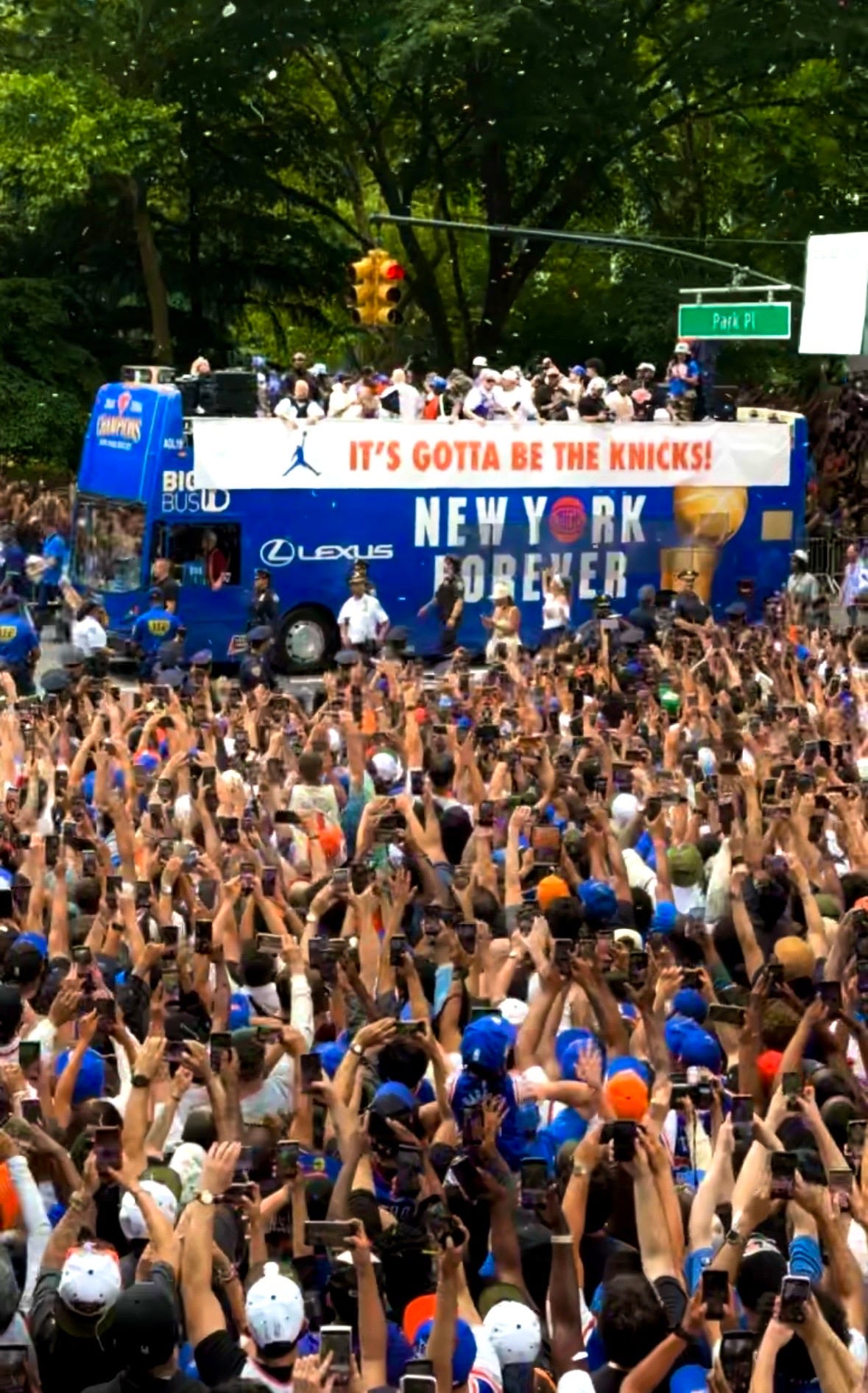
OK. Let me admit that I am a fan of basketball. The NCAA Tournament, also known as March Madness, always has me focused. When Tom Izzo’s Michigan State Spartans, my alma mater, made it to the Sweet Sixteen this year I was very excited! So, my schedule for the past few weeks has been built around the NBA playoffs between the New York Knicks and the San Antonio Spurs. I watched every game. And when the Knicks won the championship, I erupted with shouts of joy and hands in the air, along with millions of people in New York and around the world.
My younger son recently moved to New York City and got there just in time for this amazing Knicks basketball season. He tells me about the city coming alive. About people liking each other, strangers being nice to one another and just hanging out together all over the city—which he did too. Since Mamdani’s election, there has been a renewed sense of possibility and hope in New York, but the Knicks championship run took that feeling and created something that resembles unity. How long that spirit will last, and what this historic victory might mean for the city going forward remains unknown.
Perhaps the images and stories that most got my attention were the packed Subway cars with every kind of human being in this incredibly diverse global city, standing shoulder to shoulder, talking, joking, laughing, hugging, admiring each other’s Knicks swag, and even singing together before and after every game. NYC subways are not always happy places, but they became that because of the sense of community the Knicks created.
In a time of extreme, even violent, political and racial polarization, does the joy of watching amazing games with athletes so talented and seemingly committed to the success of one another show us the direction the country needs to go? Are sports showing us what real love in community can look like? Those watching and cheering were not focused on their differences but on a shared identity. They just focused on being Knicks fans together, and in doing so seemed to care about one another too.
Can sports teach us about the common good? Could they be a gateway to understanding our deep human longing for belonging, connection, and community?
Sports can teach us all about discipline, hard work, sacrifice, perseverance, and shared joy, all of which we witnessed among the victorious Knicks and all their supporters. But sports can also feed tribalism, celebrity worship, the power of money, and the kind of win-at-all-costs mentality that divides people rather than unites them.
As I was reflecting on all this, I wanted to talk to an old friend who could share a perspective from inside the game itself. Ron Adams has spent over fifty years as a coach in the NBA. He has been an assistant coach with the Golden State Warriors for more than two decades and has coached for several other teams, including the San Antonio Spurs. Along the way, he has helped lead teams to multiple NBA championships, leading the Warriors to back-to-back victories in 2014 and 2015. Ron has witnessed firsthand both the highs and lows of professional sports.

I wanted to understand what truly happens beneath the surface of the game. Why can sports sometimes bring people together across lines that usually divide us? And what does it take to build a team where people genuinely view one another as neighbors? I encourage you all to listen to our full conversation and learn more about the role of athletes in public life, the moral responsibility of fans and leaders, and perspective on sports outside of the spectacle of aggression, money, and power.
Several parts of our conversation stayed with me. I was very struck when Ron said that sports must teach you to love your neighbors, especially those who are not like you. He said, “When we give to others, when we care about others, when we are doing things for others…it makes for a special feeling within you.” Adams said that the top teams do need top talent to win, but that the true magic happens when the players actually love each other. Those become the teams that often succeed.
Ron explained that teamwork is more than just being effective, but is a moral and spiritual foundation for the player’s relationships. I asked him, as a coach, how he teaches athletes to pursue excellence without letting ego, hatred of others, and dehumanization take over. Our conversation moved beyond basketball into biblical and ethical territory. Adams reflects on teamwork, humility, sacrifice, and why “the best teams are the ones that truly care for one another.”
He explained to me that it’s all about supporting each other for the sake of the team, even when your contributions look different. When a star like Knicks’ Jalen Brunson scores 45 points in a championship game, the player who scores just 2 points can still see the value of his own contribution. Sports, at their best, teach us that life is not just about ourselves
Over his fifty years in the game, Ron has often served not only as a coach, but in many ways as a pastor to his players. He has helped form them not only as winners, but as people with character, mercy, and moral imagination.
“We’re all in it together,” Ron told me.
In a moment when so much of our culture pushes us towards isolation, division, and self-interest, that lesson may be one of the most important things sports can teach us. Even if you don’t always win, hope is never destroyed. Athletes have to continue to be hopeful, no matter what happens, just like people of faith! There is always “next year.” There is always next time, next steps, and next elections which can lead us closer to the next realities. And so much change can happen if unity is part of our next plays.
Comment on THE COTTAGE, 19 June 2026:
LeRoy Knohl
just now
How do you get a church to realize they belong on the front lines of Justice, Peace, and Righteousness? I tried to get 6 churches to Wake Up to their responsibility, but every one of them preferred to remain an "irrelevant social club" [MLK] uninterested in “making Righteousness flow like an everlasting stream” [Amos], not to ignore the scathing words of Rev. Jim Wallis, Jemar Tisby, etc.
I will no longer attend church! I now realize that those scathing remarks paint a clear picture of what churches serve in this country. Perhaps Pope Leo will shake up the institution.
Lee Knohl
I love this! Thank you for sharing your wise words. It’s what we need for this time and always a reminder.